Saturday, June 27, 2009
A strong movement toward right Islamic practice
In Islam, there are obligations upon individual and there are obligations upon ummah. Every Muslim is responsible for fulfilling his or her own individual obligations by purifying themselves, creating a healthy body and mind during the physical existence so that the soul may return to Allah. Allah has stated in the Holy Quran, "Indeed he succeeds who purifies his ownself. And indeed he fails who corrupts his ownself"(Al Quran91:9-10). The purified heart will always produce positive action, and a poluted heart will result in negative action.Responsibilities upon the ummah are usually fulfilled by only those individuals among the ummah who specifically take on that responsibility. Those individuals fulfilling collective obligation (fard kifayah) will still need the support from all other Muslims. By fully knowing and accepting our role as Servant and Khalifah (vicegerent) of Allah on this earth we will be able to produce strong Islamic personalities and a right Islamic society working only to fulfill the Will of Allah the Sustainer, who has the right to be worshipped, who is owner of this world and creator of universes. May our dream of the unity of the ummah and khilafah system become a reality.
جزاك الله خير
Jazakallah Khair
'May Allah grant you goodness'
Friday, June 26, 2009
Lustful Gaze
"The furtive glance is one of the poisoned arrows of Shaytan, on him be God's curse. Whoever forsakes it for the fear of Allah, will receive from Him (Great and Gracious is He) a faith, the sweetness of which he will find within his heart." (al-Haakim.)
Therefore, a secret lustful look at a person of opposite gender has been compared by the Prophet (pbuh) to an arrow from Shaytan that:
- poisons our hearts
- ruins our intentions
- gives rise to false hopes and desires
- distorts our perception of 'reality'
- deprives us from enjoying and concentrating in Prayers
- gives rise to constant feeling of guilt and depression
- sometimes leads to sleepless nights
- renders our heart weak for continuous Shaytanic attacks
- promotes hypocrisy
- weakens our memory
- eventually leads to Zina (adultery)
- above all, diminishes our love for and fear of Allah
"Watch Out for The Arrow" - Young Muslims Publications
From Darkness into Light
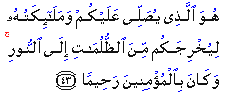
Al-Ahzab (The Confederates)
Chapter 33: Verse 43

"It is He who bestows His blessings upon you, with His angels, so that He might take you out of the depths of darkness into the light."
People are reminded of God's grace and the care He takes of His creation and the favours He bestows on them. Yet He is in no need of them while they need His care and blessings.
All glory to God who bestows great favours and doubles them over and over again. Yet He also remembers His weak servants who have no real power of their own and whose life is only transitory. He remembers them, taking care of them and blessing them together with His angels. One can hardly imagine it, when one knows that the whole earth with all the creatures living on and in it is no more than a tiny particle in relation to the great galaxies of the universe.
God's light is one, comprehensive, continuous. What does not belong to it is darkness, which differs and has several depths. If people stray from God's light, they have only darkness to live in. Nothing can save them or bring them out of this darkness except God's light that enlightens hearts and minds, filling souls and guiding them to what suits their nature. The grace God bestows on them and the angels' blessings and prayers for them are what takes them out of the darkness into the light. This is what happens to them when their hearts open up to faith.
Compiled From:
"In The Shade Of The Quran" - Sayyid Qutb, Volume 14, pp. 92, 93
Thursday, June 25, 2009
The Individual
Broadly speaking, Islam pursues its social objectives through reforming the individual in the first place. The individual is thus seen as a morally autonomous agent who plays a distinctive role in shaping the community's sense of direction and purpose. The individual is admittedly required to obey the government but he obeys the ruler on condition that the latter obeys the Shariah. This is reflected in a renowned hadith that
there is no obedience in sin, obedience is only in righteousness. [Tabrizi]
We may also quote here two other hadiths that substantiate the moral autonomy of the individual. In one of these Abu Dhar al-Ghifari reported that the Prophet, peace be upon him, ordered him to
tell the truth even if it is unpleasant. [Ahmad]
and in the other he declared that
the best form of jihad is to tell a word of truth to an oppressive ruler. [Ibn Majah]
The dignity and welfare of the individual is of central concern to Islamic law. The five essential values of Shariah on which the ulama are in agreement, namely faith, life, intellect, property and lineage are all premised on the dignity of the individual, which must be protected as a matter of priority.
Compiled From:"Shari'ah Law - An Introduction" - Mohammad Hashim Kamali
Single Heart
Al-Ahzab (The Confederate Tribes)
Chapter 33: Verse 4 (partial)
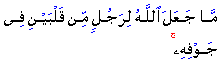
"Never has God put two hearts in one man's body"
Man cannot have one source for his manners and morality, another for his laws and legislation, a third for his social and economic values, and a fourth for his art and philosophy. Such a mixture does not produce a man with a sound heart: it only produces a confused medley that lacks solid form or basis. A person with faith cannot truly hold to his faith and abandon its values and requirements in any situation in life, serious or not. He cannot say a word, take an action, formulate a concept, make a decision unless he remains within the limits established by his faith, which must always be a reality in his life. This is because God has not given him more than one heart, one law and one standard of values. A person of faith cannot say of anything he does: 'I am doing this in my personal capacity and I am doing this in my Islamic capacity', as we frequently hear politicians, businessmen, acad emics and others say. Since he is one person with one heart, he has one faith and one standard that govern all that he does and says in any and every situation. With this one heart he lives as an individual, a family man, a member of the community, a citizen of the state and the world; he lives in public and private, employer or employee, ruler or ruled, in situations of comfort or distress; having the same values and standards at all times.
In short, we have a single system outlined by the same revelations and submitting to the One God. A single heart cannot worship two deities, serve two masters and move in two directions. Otherwise, it will be pulled apart and will have different motives and considerations. It could easily fall into the trap of hypocrisy.
Compiled From:
"In The Shade Of The Quran" - Sayyid Qutb, Volume 14, pp. 13, 14
Respecting Water

Creation is filled with signs that tell of the goodness and generosity of its Creator, and it is hence a sacred space: respecting it is akin to charity (sadaqah) or invocation. One day, as the Prophet, peace be upon him, passed Sad ibn Abi Waqqas, who was performing his ritual ablutions, the Prophet said to him: "Why such waste, O Sad?" "Is there waste even when performing ablutions?" Sad asked. And the Prophet answered: "Yes, even when using the water of a running stream." [Ahmad, Ibn Majah]
Water is essential element in all the teachings and ritual practices, for it represents the purification of body and heart, of physical outwardness as well as spiritual inwardness. But the Prophet taught Sad and his other Companions never to consider water, or any other element of nature, as a simple means towards their spiritual edification; on the contrary, respecting nature and using it moderately was already, in itself, a spiritual exercise and elevation, a goal in their quest for the Creator.
Compiled From:
"In The Footsteps of The Prophet" - Tariq Ramadan, p. 202